Phylum: Apicomplexa
Phylum Apicomplexa consists of single-celled, spore-forming parasites that infect a wide range of animals. Notable human pathogens in this group include Cyclospora cayetanensis, which causes cyclosporiasis, and Plasmodium, the genus responsible for malaria. Nearly all species are obligate intracellular parasites, meaning they cannot complete their life cycles outside of a host organism. They infect a vast range of animals, from marine invertebrates to humans.
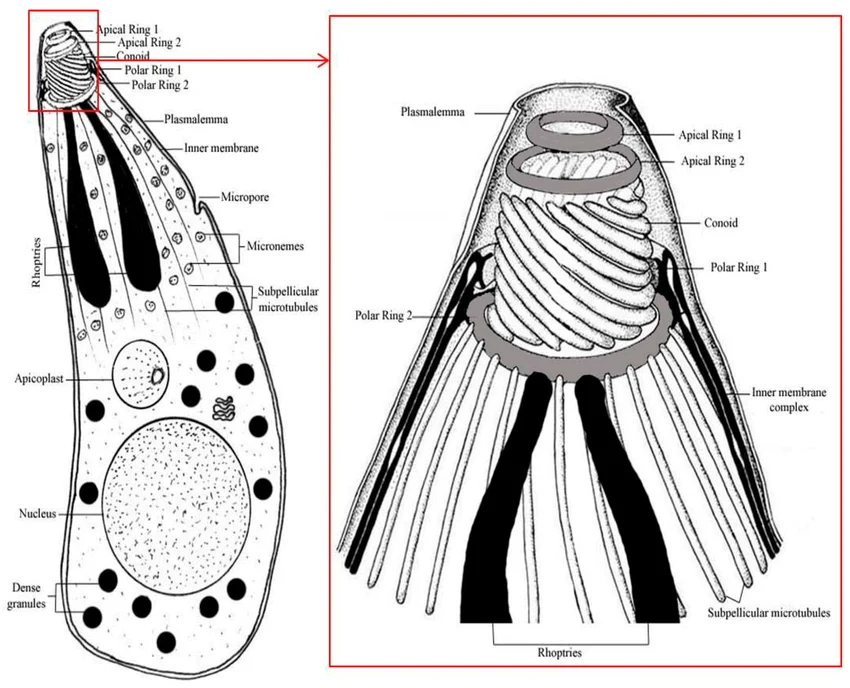
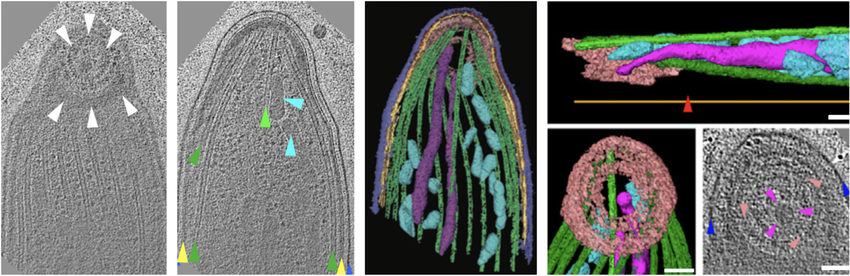
The phylum gets its name from its defining feature: the apical complex. This specialized cluster of organelles sits at the forward tip ("apex") of the parasite during its infectious stage. It includes secretory structures like rhoptries and micronemes, alongside structural elements like polar rings and a spiral conoid. Working together, these components act like a cellular drill and key, secreting enzymes and generating mechanical forces that allow the parasite to attach to and bore directly into a host's cells.
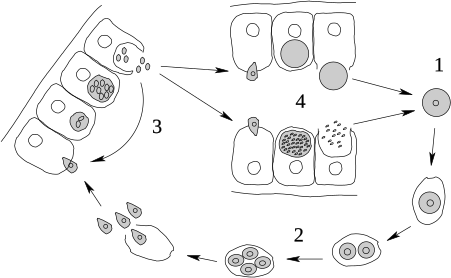
Most apicomplexans possess an apicoplast (visible in the main cell body), a vestigial, non-photosynthetic plastid derived from ancient red algae that is critical for lipid synthesis. Their life cycles are notoriously complex, typically alternating between asexual reproduction (schizogony) and sexual reproduction (gametogony).
Core Taxonomic Classes
While protozoan taxonomy frequently shifts with molecular sequencing data, Apicomplexa is traditionally broken down into three primary classes based on their life cycles, motility, and the structural presence of the conoid.
1. Conoidasida
This class is defined by having a complete, prominent conoid within the apical complex throughout most of their infectious stages. They reproduce both sexually and asexually.
Subclass Coccidia: These are primarily intestinal parasites of vertebrates. They form highly resistant oocysts that exit the host to find new targets.
Notable Genera: Cyclospora (causing cyclosporiasis), Toxoplasma (causing toxoplasmosis), and Cryptosporidium (causing cryptosporidiosis).
Subclass Gregarinasina: Large parasites that primarily inhabit the digestive tracts and body cavities of marine, freshwater, and terrestrial invertebrates (like insects and worms). They are generally harmless to humans.
2. Aconoidasida
As the prefix a- implies, organisms in this class lack a formal conoid during most or all of their life stages (except occasionally as ultra-microscopic vestiges in certain motile forms). They are blood and tissue parasites that rely on blood-feeding arthropod vectors (like mosquitoes or ticks) to move between vertebrate hosts.
Order Haemosporida: Parasites that live inside erythrocytes (red blood cells).
Notable Genus: Plasmodium (the causative agent of malaria, transmitted by Anopheles mosquitoes).
Order Piroplasmida: Tiny, pear-shaped parasites of red blood cells that do not produce oocysts or spore-like stages.
Notable Genus: Babesia (causing babesiosis, transmitted by ticks).
3. Blastogregarinina
A small, ancestral class of marine parasites that lack conventional syzygy (the pairing of gametocytes before sexual reproduction). They primarily infect marine invertebrates like polychaete worms. Their life cycles are uniquely simplified compared to mainstream conoidasids, serving as an evolutionary bridge within the phylum.
References
- Al-Quraishy, Saleh & Abdel-Ghaffar, Fathy & Dkhil, Mohamed & Abdel-Gaber, Rewaida. (2021). Haemogregarines and Criteria for Identification. Animals. 11. 170. 10.3390/ani11010170.
- Guizetti, Julien & Frischknecht, Friedrich. (2021). Apicomplexans: A conoid ring unites them all. PLOS Biology. 19. e3001105. 10.1371/journal.pbio.3001105.